Sustain calls for local food systems to be prioritised in the government’s forthcoming Food Strategy as new review of evidence shows they can be more shock resilient than incumbent systems, whilst also strengthening local economies.
Local food has long been thought of as a “nice-to-have”. But a new review of evidence finds that local food systems are often less dependent on volatile markets and can be more price stable.
The review, commissioned by Sustain and undertaken by the Organic Research Centre, examined evidence of economic benefits of local food systems from academic and grey literature, prioritising evidence from the UK and comparable markets.
The findings show that while local and regional food systems are of course not immune to disruption, they can be less exposed to price shocks.
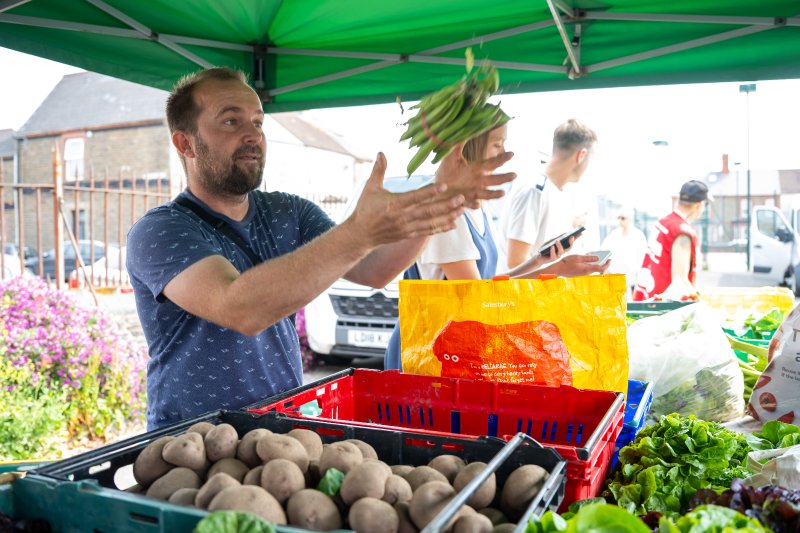
Price data from 223 Canadian farmers’ markets (2018–2023) shows that eight of eleven sampled products saw smaller price increases than national grocery stores, including potatoes (3.81% vs 7.12% annually), as well as onions, eggs, carrots, apples, strawberries and cabbages. Many vendors increased prices infrequently-just once or twice in five years - or sometimes not at all.
The review also found that local food systems exhibit characteristics which are likely to make them more resilient to disruption. Producers supplying locally are typically less reliant on synthetic inputs such as fertilisers and pesticides whose costs have risen rapidly in recent years. While local does not inherently mean organic, the review reveals that in practice there is often significant overlap. For example, one study found that vegetable producers selling directly to consumers were estimated to use around 70% fewer pesticides than those that don’t.
Producers supplying locally also tend to operate in a more diverse way, spreading risk both in terms of production and routes-to-market. A study of 252 farms participating in short food supply chains found that 75% of them produced at least three different crop types compared with 28% nationally, making them less reliant on a single product or market channels.
Sustain found strong evidence that because food supply chains involve smaller, businesses, closer supply chain relationships and more varied routes-to-market, they were more flexible and adaptable than incumbent systems during the during COVID-19 pandemic, which potentially explains the 111% surge in demand that local food suppliers experienced during that period.
Alongside these resilience factors, there is also strong evidence of local economic benefits. These included higher income for producers and greater job creation per unit of turnover, but also that short supply chains allow producers and local actors to retain more wealth compared to shareholder-driven supermarkets. A US study shows that $1 million in local food sales creates ~$750,000 in indirect economic activity versus ~$500,000 from supermarket systems.
These findings strengthen Sustain’s calls for local food systems to be prioritised in the Government’s forthcoming Food Strategy. A briefing sharing key findings from the review has been shared with all MPs and Lords.
Rachel Jones, Local Food Coordinator at Sustain said:
“Local food must be a key part of the government’s Food Strategy. We can’t avoid or fully control forthcoming shocks or price rises, but we must prepare ourselves to best weather them. Evidence is mounting that shorter and more diverse supply chains, and that are not dependent on imported chemicals, can protect supply, resist price rises and build UK resilience. The good news is that these systems already exist all over the UK, but they must be supported to make up a greater part of our supply.”
Julia Kirby-Smith, Executive Director of the Better Food Traders network said:
"Previous shocks such as the Covid pandemic have proven that local food systems and Better Food Traders are more agile, more resilient and better at keeping food prices stable than the global, commoditised food chain. Our members across the UK play a vital role in providing access to local, organic food supply. In these volatile times, we need to invest in local routes to market and more regionalised food economies, to increase UK food sovereignty and resilience."
Rowan Dumper-Pollard, Principal Researcher - Organic Systems at the Organic Research Centre said:
“What stood out from the review was the larger-scale studies from countries such as the US, Canada, France and Italy that we found. They showed that it is possible to assess the benefits of local food systems in a practical way at a national scale. At a time when farm profitability is under pressure and the resilience of the food system is being tested, the UK needs a much clearer understanding of what growing the local food sector could contribute to farm viability, regional economic activity and reducing exposure to future shocks. Working with Sustain and the expert steering group on this project has helped turn that research gap into a practical agenda for future work in this area, and it has been a valuable process to contribute to."
Published 7 May 2026
© Sustain 2026 Registered charity (no. 1018643) Data privacy & cookies